
Customer Reviews
-
★ ★ ★ ★ ★
I had a really great experience ordering from this store. The quality was excellent, delivery was on time, and everything felt smooth and well managed from start to finish.
Reviewed by: Sarah Khurram.
Reviewed on: March 5, 2026
-
★ ★ ★ ★ ★
Very satisfied with my order. The quality was very good, the payment process was easy, and the delivery service was quick and reliable. Overall, it was a really nice experience.
Reviewed by: Asim Ahad.
Reviewed on: March 2, 2026
-
★ ★ ★ ★ ★
Everything was excellent from ordering to delivery. The quality exceeded my expectations, payment was secure and simple, and the whole process was smooth and stress free.
Reviewed by: Eman Ijaz.
Reviewed on: February 25, 2026
-
★ ★ ★ ★ ★
I’m really happy with the overall service. The quality was impressive, delivery was handled properly, and the payment method was very convenient. It was a great experience for me.
Reviewed by: Alizeh Aslam.
Reviewed on: February 20, 2026
The Book Bank
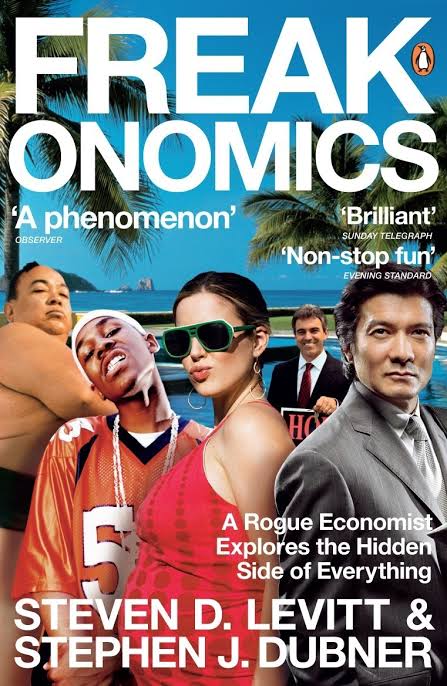
Freakonomics By Stevn D. Levitt & Stephen J. Dubner
Couldn't load pickup availability
Which is more dangerous, a gun or a swimming pool? What do schoolteachers and sumo wrestlers have in common? Why do drug dealers still live with their moms? How much do parents really matter? How did the legalization of abortion affect the rate of violent crime?These may not sound like typical questions for an econo-mist to ask. But Steven D. Levitt is not a typical economist. He is a much-heralded scholar who studies the riddles of everyday lifefrom cheating and crime to sports and child-rearingand whose conclusions turn conventional wisdom on its head. Freakonomics is a groundbreaking collaboration between Levitt and Stephen J. Dubner, an award-winning author and journalist. They usually begin with a mountain of data and a simple question. Some of these questions concern life-and-death issues; others have an admittedly freakish quality. Thus the new field of study contained in this book: freakonomics.Through forceful storytelling and wry insight, Levitt and Dubner show that economics is, at root, the study of incentiveshow people get what they want, or need, especially when other people want or need the same thing. In Freakonomics, they explore the hidden side of . . . well, everything. The inner workings of a crack gang. The truth about real-estate agents. The myths of campaign finance. The telltale marks of a cheating schoolteacher. The secrets of the Klu Klux Klan. What unites all these stories is a belief that the modern world, despite a great deal of complexity and downright deceit, is not impenetrable, is not unknowable, andif the right questions are askedis even more intriguing than we think. All it takes is a new way of looking. Freakonomics establishes this unconventional premise: If morality represents how we would like the world to work, then economics represents how it actually does work. It is true that readers of this book will be armed with enough riddles and stories to last a thousand cocktail parties. But Freakonomics can provide more than that. It will literally redefine the way we view the modern world.Bonus material added to the revised and expanded 2006 edition.The original New York Times Magazine article about Steven D. Levitt by Stephen J. Dubner, which led to the creation of this book.Seven Freakonomics columns written for the New York Times Magazine, published between August 2005 and April 2006.
Share